Policies
Maintenance of peace and stability in East Sea important to stable, long-Vietnam-China relations
By VNA 12/12/2017 08:42 |
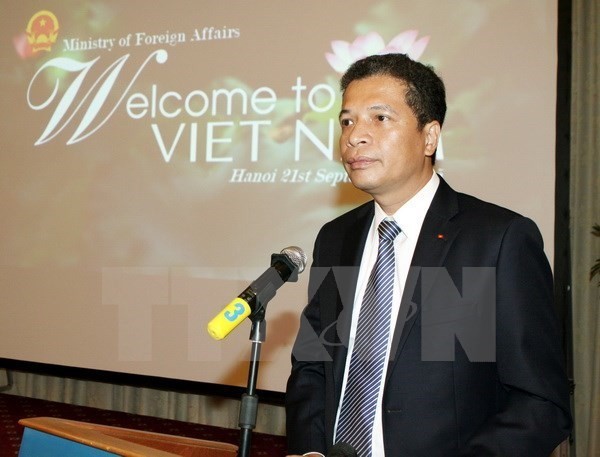
Vietnamese Ambassador to China Dang Minh Khoi (Photo: VNA)
The most important factors for the stable and long-term development of the Vietnam-China relations will be the effective implementation of their leaders’ agreements and common perceptions, good management of the differences, and maintenance of peace and stability in the East Sea, Vietnamese Ambassador to China Dang Minh Khoi has said.
The two sides should also take an active role in fostering effective negotiation mechanism and strengthening mutual trust to provide a basis for addressing more complex issues via peaceful means, international law and regional agreements, the diplomat added.
He made the points when speaking about the visit of General Secretary of the Communist Party of China (CPC) and President Xi Jinping to Vietnam city from November 10-13.
The visit aimed to further deepen the relations between the two countries, guiding the comprehensive strategic cooperative partnership to a new height, said Vietnamese Ambassador to China Dang Minh Khoi.
Xi will pay a State visit to Vietnam and attend the 25th Asia-Pacific Economic Cooperation (APEC) Economic Leaders’ Meeting in central Da Nang city from November 10-13 at the invitation of General Secretary of the Communist Party of Vietnam (CPV) Nguyen Phu Trong and President Tran Dai Quang. It is his first foreign visit and multilateral summit attendance after the CPC’s 19th National Congress, Khoi told the Vietnam News Agency during an interview in Beijing, China.
The visit shows that the CPC and State and the CPC General Secretary and President himself attach importance to the Vietnam-China relations and their support for Vietnam as the host of this year’s APEC meetings, the ambassador noted.
It is meant to deepen the bilateral relations; promote the tradition of high-level visit exchange between Party and Government leaders, and pave the way for the effective implementation of the two countries’ agreements and common perceptions for the comprehensive strategic cooperative partnership to be taken to the next level. It is also conducive to a stable and health relationship between the two sides, contributing to the cooperation within the Asia-Pacific, he stated.
As the result of efforts made by the two Parties and States, the two neighbouring countries’ friendship and comprehensive cooperation have been further strengthened with significant progress seen in all areas. A highlight of the political ties between Vietnam and China is regular high-level exchange in a variety of forms, significant to the development of the bilateral relations.
The bilateral cooperation in trade and economics has harvested many positive results. Since 2016, Vietnam has become China's largest trading partner in ASEAN and eighth worldwide. According to China’s statistics, the two-way trade reached 82.4 billion USD in the first nine months of 2017, a year-on-year increase of 20.6 percent.
China ranked eighth among 126 countries and territories investing in Vietnam. By September 2017, Chinese investors have operated 1,747 FDI projects, worth over 11.9 billion USD, in Vietnam.
People-to-people exchange and cooperation in tourism have also made good progress. There are more than 120 weekly flights between the two nations. In 2016, around 2.7 million Chinese people visited Vietnam, making Vietnam the second favourite destination of Chinese travellers in ASEAN, after Thailand, while China welcomed 2.2 million Vietnamese, the highest number in Southeast Asia.
Vietnamese and Chinese leaders have reached important common perceptions on enhancing the comprehensive strategic cooperative partnership between the two countries in a stable and healthy way.
Exchange and cooperation mechanisms between the Parties, Governments and National Assemblies as well as political-social organisations and localities of Vietnam and China have also been rolled out in a larger scale.
Vietnam and China established diplomatic ties on January 18, 1950. China is Vietnam’s biggest trade partner and largest tourism market.
The two countries have also stepped up partnerships in other areas like agriculture, water resources, environment, science-technology, transport, culture, sports, education, health care and people-to-people exchange.
The affiliation between Vietnamese and Chinese localities has been enhanced practically over the past time, with more than 30 pairs of cities and provinces establishing friendship.
After normalising their relations, Vietnam and China signed an agreement on basic principles settling border and territory-related issues and another agreement on basic principles guiding the settlement of sea-related matters in 2011, contributing to orienting the handling of the East Sea issue.
They agreed to continue to implement the Declaration on the Conduct of Parties in the East Sea (DOC) comprehensively and effectively, soon reach a Code of Conduct in the East Sea (COC), manage conflicts at sea, take no actions that complicate and expand the disputes, and maintain peace and stability in the waters.
Vietnam consistently places importance on developing the stable and long-term relationship with China, on the basis of mutual respect, mutual benefit, and equality.-VNA